
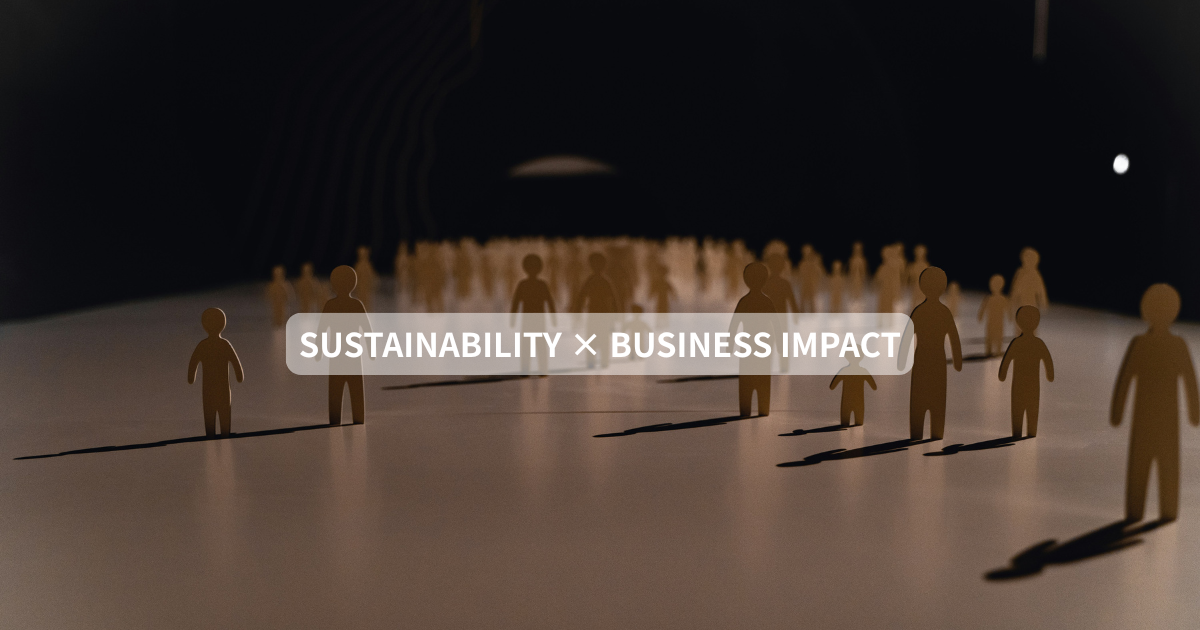
July 11th is World Population Day.
Is the world’s population increasing, or is it decreasing?
At first glance, this may seem like a simple question. For companies, however, the answer is not so straightforward.
While the global population continues to grow, many developed countries, including Japan, are facing population decline and aging societies. What matters is not only whether the population is increasing or decreasing, but where, among which age groups, and in what ways these changes are taking place.
Changes in population dynamics can affect the assumptions behind corporate decision-making, including market growth potential, talent acquisition, supply chains, relationships with local communities, and business continuity. The assumption that the necessary talent and markets will exist in the necessary locations may also be gradually beginning to change.
Seeing Population Not as a Number, but as a Structure
When we think about population, we tend to focus on the total number of people.
However, when considering corporate strategy and sustainability strategy, it is important to look at the structure behind that number.
For example, companies may need to consider questions such as:
- Which regions are seeing population growth or decline?
- Which age groups are increasing or decreasing?
- How are the working-age population and consumer behavior changing?
- How are urbanization and regional depopulation affecting the business environment?
Today, different demographic changes are taking place simultaneously around the world.
In emerging economies and certain regions, population growth and urbanization are creating new market opportunities and younger labor forces. At the same time, balancing these changes with education, infrastructure, and employment opportunities can also become a challenge.
Meanwhile, in many developed countries, including Japan, declining birth rates, aging populations, and shrinking working-age populations are increasingly affecting talent acquisition, skills transfer, social security systems, and regional economies.
In other words, population dynamics are not merely social data. They can be seen as one of the important underlying conditions for companies as they consider future markets and business continuity.
Risks and Opportunities Brought by Demographic Change
Changes in population structure are not only social issues. They are also changes in the business environment that can affect corporate activities.
From a market perspective, the products and services required in each region are changing. Regions with growing younger populations and regions with aging populations will differ in consumer behavior, purchasing channels, and the types of value that are expected.
From a talent perspective, the issue is not simply a shortage of labor. Companies may also face mismatches, where people with the necessary skills are not located where they are needed. Recruitment, training, reskilling, and the design of diverse work styles are likely to become increasingly important management issues.
For companies operating globally, demographic changes in regions where suppliers or production sites are located cannot be overlooked. Securing labor, local living conditions, reliance on migrant workers, and relationships with local communities are also connected to supply chain risks and human rights risks.
From a sustainability perspective, demographic change is linked to themes such as:
- Managing risks across the supply chain, including Scope 3
- Labor conditions and impacts on local communities in human rights due diligence
- Relationships with local communities and impacts around business sites
- Talent acquisition, development, and diversity in human capital management
- Reviewing business portfolios in light of medium- to long-term market changes
Understanding population structure is becoming important not only for identifying future risks, but also for considering new business opportunities.

The Need for Corporate Strategies That Can Be Explained
In recent years, sustainability disclosure has increasingly required companies not only to describe their initiatives, but also to explain the reasoning behind their decisions.
In the context of sustainability disclosure frameworks such as SSBJ, companies are expected to connect risks and opportunities that may affect corporate value with their management strategies.
Demographic change can be one of the underlying assumptions behind such explanations.
For example, companies may need to answer questions such as:
- Why is a particular region positioned as an important market?
- Why has a specific procurement source or production structure been selected?
- How is the company considering future talent acquisition and skills transfer?
- How does the company view its relationship with local communities?
- Has the company assessed demographic change from both risk and opportunity perspectives?
Creating a state in which these questions can be answered may become increasingly important for corporate strategy going forward.
As a first step, companies may want to examine the following points:
- What kind of population structure does the company’s business assume?
- Does the company understand changes in its markets and talent environment?
- Has the company assessed impacts on supply chains and regions where it operates?
- Can these changes be connected to management decisions as future risks and opportunities?
Demographic change is not necessarily a problem to be avoided. Rather, it is a change in the business environment that companies need to face. This is why it is important to view population not simply as a number, but as a structural change surrounding the business.
Turn Japan’s Demographic Challenges into Your Competitive Advantage

Japan is at the forefront of global demographic change. As the market shifts toward an aging society and a shrinking working-age population, traditional business assumptions are no longer enough. You need a strategy that doesn’t just react to these changes, but anticipates them.
At Neuromagic, we help forward-thinking companies successfully navigate the complexities of the Japanese market. We go beyond the numbers, helping you understand the structural changes impacting your business so you can build resilient, explainable, and profitable strategies.
How Neuromagic can support your Japan strategy:
- Market Adaptation: Pivot your products and services to align with evolving consumer behaviors and regional depopulation.
- Human Capital Solutions: Design innovative frameworks for talent acquisition, reskilling, and diverse work styles to combat labor shortages.
- Sustainability & Disclosure: Align your operations with rigorous sustainability disclosure frameworks (like SSBJ) by clearly connecting demographic risks to your management strategy.
Don’t let demographic change be a blind spot in your corporate strategy.
Whether you would like to start by understanding your current situation or by discussing where to begin, please feel free to contact us.
※For inquiries regarding the content of this blog, please select “Other” in the inquiry form above.
